Tracking · November 5, 2026 · By MooveTrax
Ride.auto vs. Turo: The Real Numbers for Fleet Operators
If you run a rental fleet, the Ride.auto vs. Turo question comes down to three numbers: what percentage of each booking you keep, how fast the money lands, and how much damage risk you carry. Most comparisons skip the numbers. Here they are.
The revenue split: a flat 80% vs. a sliding ladder
Ride.auto pays a flat 80/20 split -- you keep 80% of every marketplace booking, with no tiers and payouts that hit your bank within 24 hours. Because Ride.auto runs on Wheelbase, direct bookings you generate yourself through your own Wheelbase site aren't commissioned at all: you keep roughly 97% after standard payment processing (about 2.9% + $0.30 per transaction).
Turo's structure changed on January 7, 2026. The old five-tier ladder -- the 60, 75, 80, 85, and 90 Plans, where your host share was set by how much vehicle protection you bought -- was replaced by three US earnings plans:
- 70% host share with $250 damage responsibility (most protection)
- 80% host share with $1,500 damage responsibility
- 90% host share with $2,750 damage responsibility (most earnings)
"Damage responsibility" is Turo's post-March-2026 term for the deductible: what you pay out of pocket before Turo reimburses a covered claim. The practical takeaway: Turo's 80% plan matches Ride.auto's split, but it costs you $1,500 of exposure per incident. To beat Ride.auto's split on Turo (the 90% plan), you accept $2,750 of damage responsibility per claim -- multiplied across however many cars you run.
What Wheelbase onboarding actually requires
Ride.auto only lists vehicles from operators onboarded through Wheelbase, the fleet-management platform behind the marketplace. That's the "vetted, professionally-run business" filter in practice, and the requirements are concrete:
- Fleet size: Ride.auto is built for operators with 5+ vehicles -- it is not a side-hustle platform.
- An active Wheelbase Auto account with a verified bank account.
- Insurance configured in Wheelbase, with trip coverage running through Roamly.
- Published vehicles with accurate pricing and photos; listings sync to Ride.auto in real time.
Cost-wise, Wheelbase itself has no subscription fee -- the fixed cost is the payment-processing transaction fee, with optional paid add-ons like protection packages and roadside assistance. Ride.auto says a prepared operator can complete setup in under an hour. Turo, by contrast, remains an open marketplace: nearly anyone with an eligible car and a clean record can list, and a 40-car operator works through the same host tools as a one-car host.
Side by side
| Feature | Ride.auto | Turo (US, 2026) |
|---|---|---|
| Host share | Flat 80% | 70% / 80% / 90% by plan |
| Damage responsibility | Trip coverage via Roamly | $250 / $1,500 / $2,750 by plan |
| Direct bookings | ~97% kept via Wheelbase (processing fees only) | Not supported on-platform |
| Payout speed | Within 24 hours | ~3 business days after trip start |
| Who can list | Vetted operators, 5+ vehicles, Wheelbase onboarding | Open marketplace, individual hosts welcome |
| Insurance track | Roamly, configured in Wheelbase | Turo-embedded protection plans |
| Guest demand | Newer, smaller marketplace | Largest peer-to-peer car sharing marketplace |
That last row matters. Turo's open marketplace is also its advantage: more guests, more search volume, more bookings per listed car in most markets. Ride.auto's pitch is a better split on the bookings you get, plus a direct-booking channel Turo doesn't offer. Many operators will run both and let the calendars compete.
The insurance tracks are not interchangeable
On Turo, protection is embedded in your earnings plan. On Ride.auto, coverage runs through Roamly and is configured inside Wheelbase before your cars go live. If you're moving a fleet across platforms -- or straddling both -- confirm what your telematics and documentation need to look like under each program before the first trip, not after the first claim.
Where your tracking stack fits
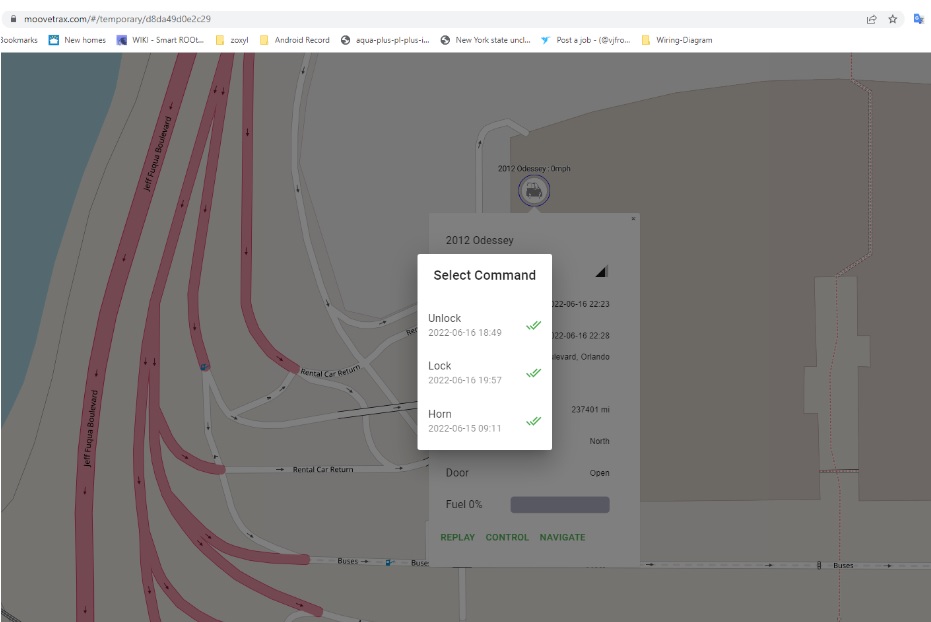
Here's the part that doesn't change with the marketplace: the car still needs GPS, a kill switch, and a paper trail. A MooveTrax device behaves identically whether the booking came from Turo, Ride.auto, or your own Wheelbase site -- GPS tracking at up to 30-second intervals, remote immobilization, lock/unlock, geofences, toll and mileage tracking, and late-return alerts, from $40 hardware and $12.50/month (or $10/month with no hardware on Tesla and OEM-connected vehicles). If you split your fleet across platforms, the tracking layer is the one piece you install once and keep.
Run the split math for your own fleet, factor in each platform's demand in your market, and let the protection numbers -- not the headline percentage -- decide.
Frequently asked questions
How much does Ride.auto pay hosts compared to Turo?
Ride.auto pays a flat 80% of every marketplace booking with payouts within 24 hours. Turo's US earnings plans (effective January 7, 2026) pay 70%, 80%, or 90% depending on how much damage responsibility you accept ($250, $1,500, or $2,750 per incident respectively).
What happened to Turo's 60/75/80/85/90 protection plans?
Turo retired the five-tier plan ladder on January 7, 2026, replacing it with three earnings plans (70/80/90% host share). In March 2026 it also renamed "deductible" to "damage responsibility" and "host take rate" to "host share."
What do I need to list cars on Ride.auto?
An active Wheelbase Auto account with a verified bank account, insurance configured through Roamly, and published vehicles with accurate pricing and photos. Ride.auto targets professional operators with 5+ vehicles; Wheelbase itself has no subscription fee, only payment-processing costs.
Can I list the same fleet on both Ride.auto and Turo?
Yes. Many operators run both and let demand decide. Keep calendars synced to avoid double-bookings, and confirm your insurance obligations under each platform's program, since Roamly and Turo's embedded protection are separate tracks.
Does MooveTrax work on both platforms?
Yes. The hardware is platform-agnostic: GPS tracking, remote kill switch, lock/unlock, geofences, and toll/mileage tracking work the same regardless of which marketplace sent the booking. Plans start at $40 hardware + $12.50/month, or $10/month hardware-free for Tesla/OEM-connected vehicles.
See how MooveTrax works for professional fleet operators.
MooveTrax for Ride.auto Fleets Compare PricingRide.auto and Turo fee structures are drawn from each platform's public pages as of November 2026 and may change -- confirm current terms directly with each platform before switching.