
October 30, 2026 · By MooveTrax
Car Theft Statistics 2026: The Numbers Nobody Markets To You
If you read vehicle security marketing right now, you'd think car theft is spiraling out of control. It isn't -- not nationally, and not by a small margin. Here's what the actual data says, and why it still matters.
The headline: theft is falling, fast
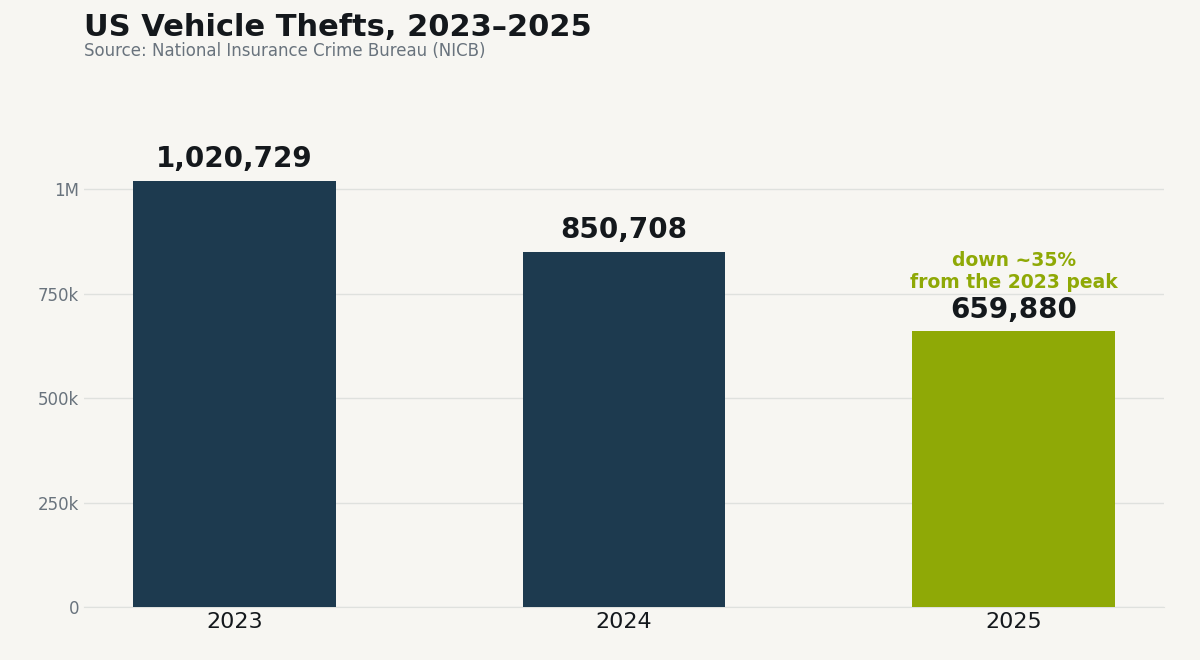
According to the National Insurance Crime Bureau (NICB), US vehicle thefts peaked at 1,020,729 in 2023. They fell to 850,708 in 2024 -- the largest single-year drop in 40 years at the time. Then they fell again in 2025, to 659,880, another drop of roughly 23%. That's a decline of about 35% from the 2023 peak, and the Insurance Information Institute (Triple-I) says theft is now at its lowest level in decades. 49 states, DC, and Puerto Rico all reported fewer thefts in 2025 than the year before.
If a security company's pitch to you starts with "car theft is surging," ask them for their source. It's very likely they don't have one -- or they're citing numbers that are two or three years stale.
So why does this still matter?
Because "falling" and "solved" are not the same thing. A few numbers worth sitting with:
One theft every 48 seconds
659,880 thefts a year works out to roughly one vehicle stolen somewhere in the US every 48 seconds. The rate has dropped a lot -- but it hasn't dropped to zero, or close to it.
About 1 in 5 is never recovered
Roughly 21% of stolen vehicles in 2025 were never recovered -- close to 138,000 cars, gone for good. Even among recovered vehicles, only about a third turn up the same day they were taken.
Most cities are still above pre-pandemic levels
The Council on Criminal Justice's year-end 2025 report found that the average city motor-vehicle-theft rate was still about 9% higher than 2019, and 21 of the 34 cities in its study had a higher theft rate in 2025 than they did before the pandemic. The national decline is real, but it's a decline from an unusually bad few years -- not necessarily a return to "normal."
Hyundai and Kia are still wildly over-represented
Hyundai and Kia models made up about 14% of all US vehicle thefts in 2025, per NICB -- down from 21% in 2023 as software theft-deterrent patches rolled out, but still far above what their share of cars on the road would predict. Millions of older models built without engine immobilizers are still on the road.
The thefts that remain are getting more technical, not less
As the easy, opportunistic thefts have declined, the methods behind the thefts that are still happening have shifted toward attacks on keyless entry and factory electronics rather than broken windows and hot-wiring:
- Relay attacks extend a key fob's signal from inside a house to a car in the driveway, tricking the car into thinking the key is present. Testing by Germany's ADAC found roughly 85% of 800+ keyless vehicles tested were vulnerable to this method.
- Key cloning copies a key's wireless identity so a duplicate can unlock and start the car without ever touching the original.
- CAN-bus injection -- documented in real US thefts -- involves plugging into the car's internal network, often through a headlight wiring harness, and sending it fake "this is a valid key" messages directly.
All three methods have something in common: they convince the car that the thief is authorized. The car's own factory security -- the thing most owners are relying on by default -- is specifically what gets fooled. That's a different problem than "did the thief break a window," and it needs a different answer.
What actually still works
None of the methods above can argue with a hardwired kill switch wired Normally Closed into the starter circuit -- a relay signal, a cloned key, or a spoofed CAN message can unlock the doors and pass every check the car's own computer runs, but it still can't close a circuit that was physically interrupted. See why most kill switches fail anyway, and the wiring choice that fixes it.
Two automatic layers matter most against the attack methods above:
- A kill switch that arms itself on a schedule -- MooveTrax's MT3V, KS, and WATER tiers all support a scheduler that can disable starting during set hours and re-enable automatically later, so an overnight relay or CAN attack meets a car that's immobilized by default, not one the owner has to remember to lock down.
- A kill switch that arms itself when you walk away -- the MT3V tier specifically kill-switches and locks the moment the paired phone leaves proximity, and re-enables when it returns. A cloned or relayed key doesn't help if the car's security is tied to a phone that isn't there.
And because roughly a fifth of stolen vehicles are never recovered, live GPS tracking and towing-detection alerts still matter as the layer behind the layer -- the thing that gives you and law enforcement a real shot at getting the car back if someone does manage to drive it away.
See the full tier breakdown for which of these features come with which device.
Sources: National Insurance Crime Bureau 2025 theft data; FBI Uniform Crime Report; Insurance Information Institute; Council on Criminal Justice, Year-End 2025 Crime Trends Update; ADAC keyless vehicle testing.